The non-German Germanic languages language group (0.5%) like Danish, Dutch and Frisian were located in the north and northwest of the empire, near the borders with Denmark, the Netherlands, Belgium, and Luxembourg. Low German was spoken throughout northern Germany and, though linguistically as separate from High German (Hochdeutsch) as from Dutch and English, is considered "German", hence also its name. Danish and Frisian were spoken predominantly in the north of the Prussian province of Schleswig-Holstein and Dutch in the western border areas of Prussia (Hanover, Westphalia, and the Rhine Province).
Polish and other Slavic languages (6.28%) were spoken chiefly in the east.[17]
A few (0.5%) spoke French, especially in the Reichsland Elsass-Lothringen, where French-speakers formed 11.6% of the total population.
1900 census results
| Language | Count | Percentage |
|---|---|---|
| German | 51,883,131 | 92.05 |
| German and a foreign language | 252,918 | 0.45 |
| Polish | 3,086,489 | 5.48 |
| French | 211,679 | 0.38 |
| Masurian | 142,049 | 0.25 |
| Danish | 141,061 | 0.25 |
| Lithuanian | 106,305 | 0.19 |
| Kashubian | 100,213 | 0.18 |
| Wendish (Sorbian) | 93,032 | 0.16 |
| Dutch | 80,361 | 0.14 |
| Italian | 65,930 | 0.12 |
| Moravian (Czech) | 64,382 | 0.11 |
| Czech | 43,016 | 0.08 |
| Frisian | 20,677 | 0.04 |
| English | 20,217 | 0.04 |
| Russian | 9,617 | 0.02 |
| Swedish | 8,998 | 0.02 |
| Hungarian | 8,158 | 0.01 |
| Spanish | 2,059 | 0.00 |
| Portuguese | 479 | 0.00 |
| Other foreign languages | 14,535 | 0.03 |
| Imperial citizens on 1 December 1900 | 56,367,187 | 100 |
Linguistic maps
-
 French
-
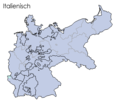 Italian
-
 non-German


Religion

Emperor Wilhelm II, who was the Supreme Governor of the Evangelical Church of Prussia's older Provinces, and Empress Augusta Victoria after the inauguration of the Evangelical Church of the Redeemer in Jerusalem (Reformation Day, 31 October 1898).
Politically, confessional division of Germany had considerable consequences. In Catholic areas, the Centre Party had a big electorate. On the other hand, Social Democrats and Free Trade Unions usually received hardly any votes in the Catholic areas of the Ruhr. Although, it began to change with the arising secularization in the last decades of the German Empire.
| Area | Protestant | Catholic | Other Christian | Jewish | Other | |||||
|---|---|---|---|---|---|---|---|---|---|---|
| Number | % | Number | % | Number | % | Number | % | Number | % | |
| German Empire | 28.331.152 | 62,63 | 16.232.651 | 35,89 | 78.031 | 0,17 | 561.612 | 1,24 | 30.615 | 0,07 |
| Prussia | 17.633.279 | 64,64 | 9.206.283 | 33,75 | 52.225 | 0,19 | 363.790 | 1,33 | 23.534 | 0,09 |
| Bavaria | 1.477.952 | 27,97 | 3.748.253 | 70,93 | 5.017 | 0,09 | 53.526 | 1,01 | 30 | 0,00 |
| Saxony | 2.886.806 | 97,11 | 74.333 | 2,50 | 4.809 | 0,16 | 6.518 | 0,22 | 339 | 0,01 |
| Württemberg | 1.364.580 | 69,23 | 590.290 | 29,95 | 2.817 | 0,14 | 13.331 | 0,68 | 100 | 0,01 |
| Baden | 547.461 | 34,86 | 993.109 | 63,25 | 2.280 | 0,15 | 27.278 | 1,74 | 126 | 0,01 |
| Alsace-Lotharingia | 305.315 | 19,49 | 1.218.513 | 77,78 | 3.053 | 0,19 | 39.278 | 2,51 | 511 | 0,03 |
Bismarck era
|
Part of a series on the
|
|---|
| History of Germany |
 Germany portal |

Bismarck's "revolutionary conservatism" was a conservative state-building strategy designed to make ordinary Germans—not just the Junker elite—more loyal to throne and empire. According to Kees van Kersbergen and Barbara Vis, his strategy was:
- granting social rights to enhance the integration of a hierarchical society, to forge a bond between workers and the state so as to strengthen the latter, to maintain traditional relations of authority between social and status groups, and to provide a countervailing power against the modernist forces of liberalism and socialism.[19]

I will recommend anyone looking for Business loan to Le_Meridian they helped me with Four Million USD loan to startup my Quilting business and it's was fast When obtaining a loan from them it was surprising at how easy they were to work with. They can finance up to the amount of $500,000,000.000 (Five Hundred Million Dollars) in any region of the world as long as there 1.9% ROI can be guaranteed on the projects.The process was fast and secure. It was definitely a positive experience.Avoid scammers on here and contact Le_Meridian Funding Service On. lfdsloans@lemeridianfds.com / lfdsloans@outlook.com. WhatsApp...+ 19893943740. if you looking for business loan.
ReplyDelete